Baroque pop luminary and showman Rufus Wainwright brought an epic reimagining of his Want One and Want Two albums to Manchester, following a premiere performance at the BBC Proms and subsequent tours across Europe and the US. The Canadian-American singer, songwriter, and composer has long been celebrated for his opulent arrangements and genre-defying style, blending glossy pop, alt-rock, classical compositions, and jazz into a rich tapestry of sound.
With ten studio albums, multiple Grammy and Juno nominations, and operatic and film score commissions to his name, Wainwright’s musical accolades are as diverse as his influences.
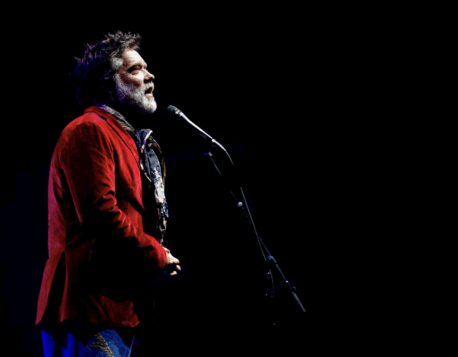
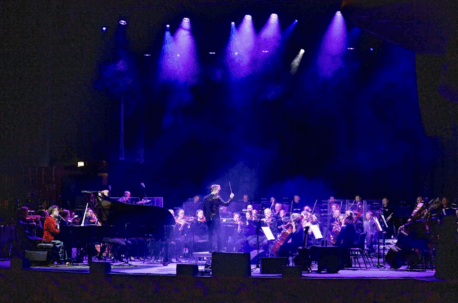
For two nights at the O2 Apollo Manchester, Wainwright revisited his Want records, accompanied by the BBC Philharmonic Orchestra. With sweeping depth and new arrangements, the repertoire was as dreamy as it was cinematic. Conductor Lee Mills, a long-time Wainwright collaborator, brought incredible scale, adding drama and flair to the evening.
Saturday’s Want Two performance was dedicated to the 2004 release, an album Wainwright introduced on the night as “… the most mysterious of the two albums. We’re going to go on quite the journey. Here we go.”
The show commenced with the opening track, Agnus Dei; a classical piece arranged by Wainwright himself. Written in Latin, the song is a call for mercy, and it began with a sharp, jagged squeak of violin strings that eased into a melody of evocative Middle Eastern influence, carried by piano. While playing the keys, Wainwright’s voice echoed into a prayer-like cry, the music building slowly into a powerful crescendo by the end.
Next came the soft, romantic ballad, Peach Trees, followed later by a poignant rendition of Memphis Skyline. Before the latter, Wainwright shared his story behind the song, admitting that he had once felt jealousy toward Jeff Buckley, avoiding his music entirely, and even refusing to hear his version of Hallelujah. However, when a chance encounter led to a night of partying together, Wainwright realised he had been wrong to hold onto such resentment for so long. Tragically, just weeks later, Buckley’s sudden death inspired the song that would become this tribute.
Between the music, Wainwright wove intimate storytelling and anecdotes from his life, nodding to friends and family in the audience, including his husband, Jörn Weisbrodt. I even found myself seated next to one of his long-time family friends, who beamed with pride throughout the night.
Elsewhere, Little Sister explored Wainwright’s relationship with his own sister, Martha, while drawing inspiration from Mozart – joking that, when performing the piece in Austria years before, he had somehow offended the spirit of the composer.
A running theme throughout was Wainwright’s lament for the state of America, and he closed the show on a note of vulnerability with Leonard Cohen’s ‘Hallelujah’. Overcome with emotion around the second verse, he invited the audience to sing along, creating an unforgettable finale to a breathtaking performance.
- Words:
- Rebekah Spratt
- Published on:
- Sat 4 Oct 2025

