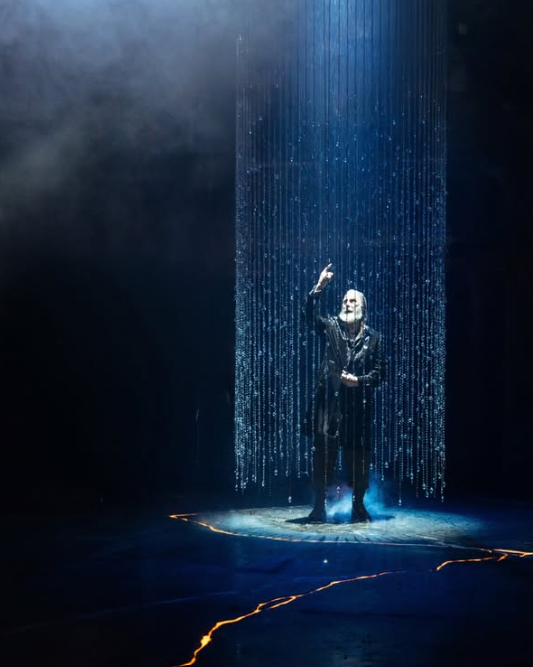
The inimitable David Threlfall makes a formidable return to the Royal Exchange in Matthew Dunster’s richly charged interpretation of King Lear, a production that brings fresh urgency to Shakespeare’s devastating study of power, family and the fragility of human identity.
Arriving as part of the theatre’s 50th anniversary celebrations, this is a fittingly ambitious homecoming, with Threlfall and Dunster bringing their long-standing connections to the Exchange to one of the playwright’s most elemental works. Recast in a contemporary world of dynastic machinations and century-spanning garb, the tragedy finds an unsettling modern resonance in the grimly familiar tale of a powerful man whose authority has outlived his command of sincere affection, without losing its unmistakable sense of encroaching catastrophe.
As he shuffles irreversibly into decay and fateul paranoia, Lear mistakes flattery for loyalty and the allure of inheritance for unconditional love from his cynical children, setting in motion an excrutiating chain of betrayals that leaves both kingdom and family in ruins. As his authority crumbles in tandem with his mental clarity, Threlfall’s king renders Shakespeare’s great questions of truth, madness and humanity in a visceral, discomforting physical language that masterfully captures both regal grandeur and the terrible vulnerability of a man stripped of the certainties that once defined him, embodying the contradictions of a ruler whose imperious pride gives way to bewilderment, and whose fury gradually exposes a more painful recognition of his own limitations.
Dunster, returning for his sixth Royal Exchange engagement as adapter and director, approaches the play as an intimate human calamity as much as a political one – modern audiences will note the echoes of Lear-inspired inheritance drama Succession – allowing its enduring themes of generational conflict, ambition and responsibility to resonate beyond the trappings of the abstracted royal court. His contemporary framing sharpens the spectacle of an encircled patriarch losing his grip on the world he has shaped, while Anna Fleischle’s evocative design and the production’s volatile atmosphere lend physical form to the ceaseless disintegration, with spangled string curtains dividing the stage into shifting territories and molten fault lines giving a novel yet judicious representation of fracture running through the kingdom and family.
The wider company gives Shakespeare’s parallel stories of deceit and belated recognition a remarkable force, with Jonathan Slinger bringing a bruised humanity to Gloucester and Isobel Akuwudike offering a quietly compelling counterpoint as the pure-hearted Cordelia. Mercury-prize nominated musician Nadine Shah makes a distinctive contribution in dual capacities, appearing onstage in a memorable turn as Goneril while also composing the production’s prowling, pulsating score.
There is a particular poignancy to seeing Threlfall and Dunster return to a theatre with which they share such a rich history, and King Lear makes an apt centrepiece for the Royal Exchange’s landmark anniversary year. Shakespeare’s tragedy remains an extraordinary examination of what happens when power becomes detached from compassion, and this new staging places that unsettling truth firmly before a contemporary audience in a certain classic for the Manchester institution.
A commanding addition to the Royal Exchange’s 50th anniversary programme, King Lear offers a stirring reminder of Shakespeare’s capacity to bring immediacy to the ancient, and of the theatre’s continuing appetite for work that challenges and moves in equal measure.
King Lear runs until Sun 15 Nov. Book tickets below.
Fri 2 Oct - Sun 15 Nov, Royal Exchange Theatre, St Ann's Square, Manchester M2 7DH, From £15
- Words:
- Wolf McFarlane
- Published on:
- Sat 10 Oct 2020

